
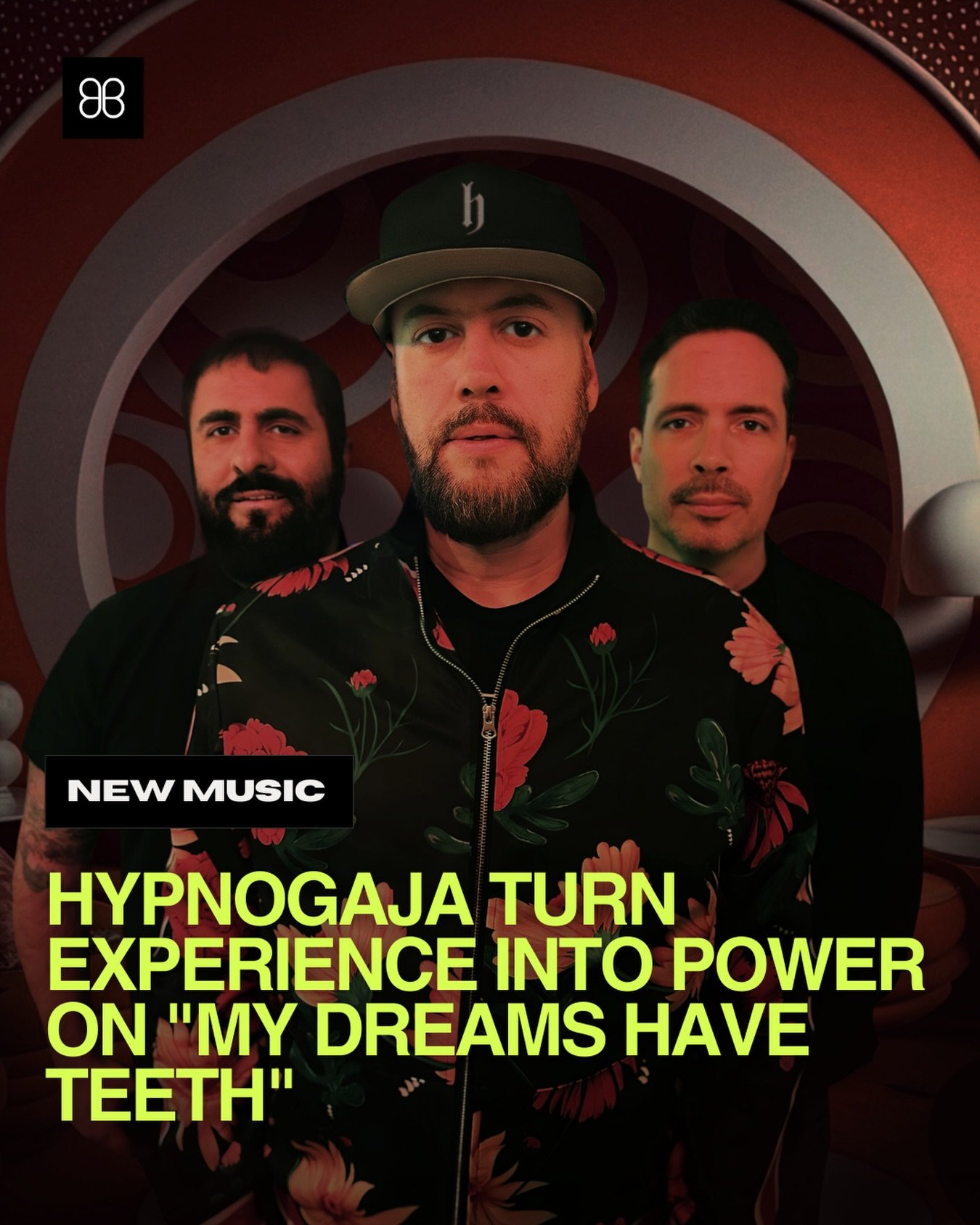
After more than a decade between full-length releases, Hypnogaja doesn’t sound like a band easing back into the room. My Dreams Have Teeth arrives with intention. The Los Angeles outfit, fronted by ShyBoy, has always lived in the space where melody meets pressure, but this record sharpens that contrast into something cinematic and physical. Released via Snafu Records, the album feels less like a comeback and more like a statement of position: this is where the band stands now, heavier with experience, tighter in execution, and fully aware of its identity.
“Open/Wide” does exactly what its title promises. The album begins at full scale, stretching atmosphere and guitar into a widescreen introduction that establishes the emotional stakes immediately. “Escalate” follows by tightening the screws, its pacing deliberate and coiled, proving why veteran journalist Larry Flick described the band’s sound as defined by tension and control. The track builds rather than bursts, trusting restraint as a form of power. On “Stranger Inside,” the mood turns inward. The song plays like a conversation with the self, layered electronics brushing against distorted guitars while ShyBoy’s vocal cuts clean through the fog.
“Ghost In The Hallway,” co-written with Matt McJunkins of A Perfect Circle, leans fully into gothic architecture. The arrangement feels cavernous, echoing with unease, yet the melody anchors it in something deeply human. That balance continues on “Pictures Of A Perfect You,” a dance-rock pulse wrapped around modern anxiety, especially in the cutting observation that the algorithm has rhythm enough to control us even if it can’t feel. It’s seductive and unsettling at the same time. “This isn’t going to end well” pivots into fatalistic clarity, its title functioning like a thesis statement delivered over grinding guitars and electronic textures that feel engineered to close in around the listener.
The middle stretch of the album deepens the nocturnal atmosphere. “Things That Go Bump In The Night” plays with tension like a thriller score, while “I Need a Moment” finally exhales, giving the record space to breathe without losing its edge. That quiet doesn’t last long. “Dead of Winter” freezes everything in place, emotionally and sonically, turning isolation into a physical sensation. The band’s reimagining of Sade’s “Is It A Crime” strips the classic to its emotional skeleton and rebuilds it inside Hypnogaja’s shadowy architecture. Like their long-running interpretation of Eurythmics’ “Here Comes the Rain Again,” it proves the band understands how to translate timeless songwriting without flattening its soul.
The closing run feels like the aftermath of a long night. “The House Always Wins” carries a gambler’s resignation, its rhythm steady and inevitable. “Just One More Game” pushes that metaphor further, caught between compulsion and awareness. By the time “Pieces of Goodbye” arrives, the album feels earned. The final track doesn’t explode. It lingers, assembling fragments of loss, healing, and acceptance into a quiet comedown that refuses easy closure.
My Dreams Have Teeth reflects a band shaped by years of work across music, film, and television, including ShyBoy’s recent compositions for Bryan Fuller projects like Dust Bunny and the Emmy-nominated Queer For Fear. That cinematic instinct runs through every track, but the core remains connected. Hypnogaja aren’t chasing trends or nostalgia. They’re documenting where they stand right now, and in a world carrying its own weight, the album’s darkness feels less like escape and more like recognition. It meets the listener at eye level and stays there.
After more than a decade between albums, what did you refuse to carry over from the old Hypnogaja era, and what parts of your identity felt non-negotiable when building My Dreams Have Teeth?
We really wanted to make an album that connects with our longtime fans while also inviting them to discover - along with new audiences - where we are in our lives and creative process now. People and times change, and as an artist, the hope is to honestly shape one’s work in a way that reflects what’s currently happening in life. Also, all of us have worked on a lot of projects in different genres since our last album, so we really wanted to incorporate our growth while still capturing the spark of what brought us here in the first place.
The album feels cinematic in a way that borders on horror at times. If this record were a film, what’s the opening scene and what’s the final shot the audience walks out with?
Interesting that you bring up the horror element. Horror has always been an allegory for something deeper at work in society, current times being no exception. Over the course making My Dreams Have Teeth, we wanted to create something that feels like an overall experience, where the characters and stories come together to express conflict, excitement, commentary, aspiration, and redemption. Cinematic horror elements may also be reflected in the fabric of the album since it was recorded concurrently with horror-related composition projects we worked on (Bryan Fuller’s film Dust Bunny and the documentary Queer For Fear: The History of Queer Horror). If this record were a film, our opening scene would probably be from The Shining (that foreboding, winding road really sets the stage) and our closing scene could be from The Birds. Not everything is resolved, but something has shifted.
Your version of “Is It A Crime” doesn’t play like a cover so much as a translation. What’s the line between honoring a classic and hijacking it into your own emotional universe?
Every time we cover a song, we do it because we love it - and we love the artist’s original vision. So with that as a starting point, we ask how it fits in the universe of our music and what we can do to capture the essence of the original while also translating it into our own musical language - not out of vanity but as a form of emotional expression and communication with the audience. We adore Sade. It’s always fun to interpret music by artists who are in totally different genres and from different eras. A great song can be presented in a multitude of ways - as long as the integrity of the original is maintained and honored, which we always strive for whenever remaking something.
A lot of these songs wrestle with control, technology, and modern anxiety. Do you think we’re getting better at coping with the world, or just better at disguising how overwhelmed we are?
Probably both. Humans are incredibly adaptive, but adaptation can sometimes look like suppression. We get better at functioning without necessarily getting better at processing. On this album, we really wanted to talk about the real pressures affecting not just us but all of those around us. Music is a great connector. We hope that in sharing our feelings on how overwhelming the world can be at times, it creates a sense of comfort in those who are listening to our songs.
You’ve worked across film, television, pop, and alternative spaces. When you step back into Hypnogaja mode, what creative rules change, and what freedoms open up that you can’t access anywhere else?
We are lucky to have been around long enough to know what our audience wants while also having the experience to know what we want as artists. Creating music in the context of a band setting carries an unbridled sense of freedom - we can go anywhere when we have each other to guide us. There’s nothing quite like it - and we are excited and grateful that we get to experience it together again.